
Welcome to This Month’s Newsletter
Low back pain is common, confusing, and often alarming. One day it’s a dull ache; the next it’s stopping you from tying your shoes. Before jumping to worst-case conclusions or quick fixes, it helps to slow down and assess what your body is telling you. In this newsletter, we’ll break down how to make sense of your symptoms, what patterns matter, and which red flags deserve attention. You’ll learn simple questions to ask yourself, how movement, posture, and stress play a role, and when self-care is appropriate versus when to seek professional help, so you can respond with clarity. calmly.
There are four influences on low back pain...
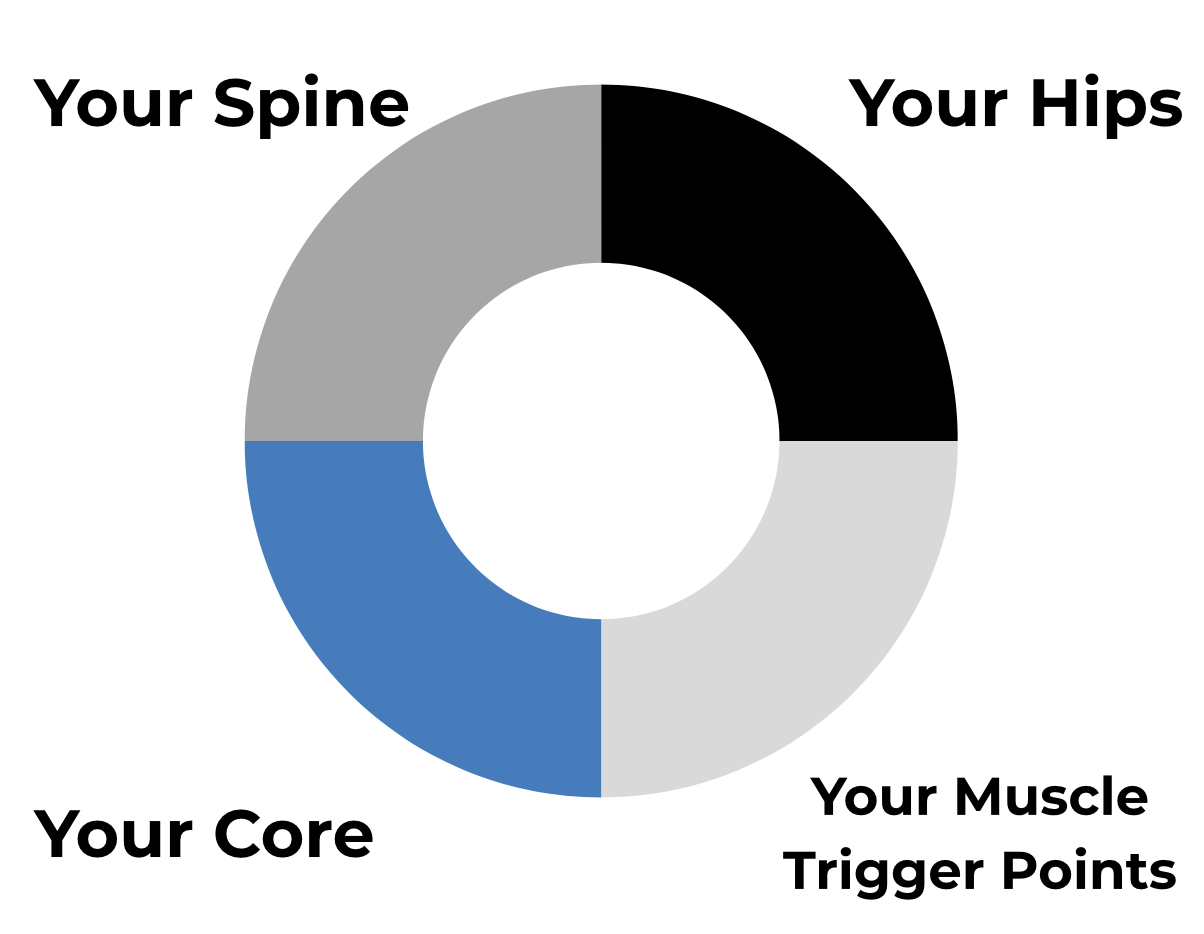
Your Spine
For example, the posture of your spine could be triggering pain, it could be flexion and/or extension, with both pointing toward the disc and extension pointing to facet joints as well. The basic question being asked here is, what posture or load triggers pain?
Your Hips
Hip range of movement has been linked to low back pain, particularly internal rotation. Doing a hip range of movement assessments helps this become clearer. Here, we're asking, in what ranges of movement are they limited? Could it be influencing their pain?
Your Core
Assessing the core can be done in two ways, core stability and core endurance. Understanding which is the most limited helps with exercise selection rather than saying "do these 4 exercises". Is stability or endurance the most limiting factor?
Muscle Trigger Points
An underutilised assessment, muscle trigger points are active muscle knots and depending on the muscle it can refer pain to the low back, buttocks or down the leg. Also general muscle tension around the low back and hips are useful to know.
Putting it together
After assessing low back pain you might find that one of these stands out, two, three or even all four. If you find more than one influence, tackle them one at a time. For example, if they have muscle tension in the low back and poor core stability, priorities on the muscle tension first because a tense low back will always be vulerable no mater how stable.
Click the button below to start the Looking for Low Back Pain Triggers Part 1
Got a Question
Got something you’re curious about—training, technique, recovery, or anything in between? This is your space to ask. Send in your questions, and we’ll tackle them with clear, practical answers to help you keep progressing with confidence.
Responses